

Benchmarks: clobe#
The R package clobe 0.8.0 against its port psp.clobe, on the same machine and the same inputs.
clobe’s functions are written in C++ (Rcpp and RcppArmadillo) and called from R once per result, pattern set or enumeration; brutes() runs on every core with RcppParallel. The port does the same work as tensor operations: on whole batches of results at once, on the CPU or on the GPU. This notebook measures what that buys and what it costs, function by function, and checks that both give the same answers.
The workloads and how they are measured are described in ../benchmarks/clobe/README.md. In short: every call is timed as a user would make it, from inputs already in memory (on the GPU, already on the device) to the result, and each figure is the median of up to five samples after a warm-up call. Everything is float64. The checksum of each result (a sum of the cells, a count or the g-distance) is computed in the timed call on both sides.
import platform
import subprocess
from pathlib import Path
import numpy as np
import pandas as pd
import torch
from IPython.display import Markdown, display
import matplotlib.pyplot as plt
from figure_style import figures, titled

show = figures("benchmarks-clobe")

grey, muted = "#6c757d", "#6c757d"
R = "clobe 0.8.0 (R)"
builds = {"psp-torch cpu float64": "#eb6834", "psp-torch cuda float64": "#1baf7a"}
short = {"psp-torch cpu float64": "torch CPU", "psp-torch cuda float64": "torch GPU"}


def duration(s):
    if s >= 1:
        return f"{s:,.2f} s"
    if s >= 1e-3:
        return f"{1e3 * s:,.2f} ms"
    return f"{1e6 * s:,.1f} µs"


def times(v):
    return f"{v:,.0f}×" if v >= 10 else f"{v:.2g}×"


results = Path("../benchmarks/clobe/results")
runs = pd.concat([pd.read_csv(results / "r.csv"), pd.read_csv(results / "torch.csv")])
runs["size"] = runs["size"].astype(int)
order = list(dict.fromkeys(runs["function"]))
seconds = runs.pivot_table(index=["function", "size"], columns="build", values="seconds")
seconds = seconds.reindex(sorted(seconds.index, key=lambda i: (order.index(i[0]), i[1])))
check = runs.pivot_table(index=["function", "size"], columns="build", values="check")
cpu_name = subprocess.run(["sh", "-c", "lscpu | sed -n 's/^Model name: *//p'"],
                          capture_output=True, text=True).stdout.strip() or platform.processor()
gpu_name = torch.cuda.get_device_name(0) if torch.cuda.is_available() else "no GPU"
display(Markdown(f"Measured on one machine: {cpu_name} and {gpu_name}. The R package's `brutes()` "
                 f"runs on every hardware thread; torch {torch.__version__} uses "
                 f"{torch.get_num_threads()} CPU threads."))
Measured on one machine: AMD Ryzen 7 5800X 8-Core Processor and NVIDIA GeForce RTX 3060. The R package’s brutes() runs on every hardware thread; torch 2.11.0+cu128 uses 8 CPU threads.
Same answers#
For every workload, the checksum of the port’s result against the R package’s. Counts and sums of cells must be equal; g-distances may differ in the last bits, because the GPU adds the frequencies in a different order.
agree = pd.DataFrame(index=check.index)
for build in builds:
    torch_check = check[build].dropna()
    exact = np.isclose(torch_check, check.loc[torch_check.index, R], rtol=1e-12, atol=0)
    agree[short[build]] = pd.Series(np.where(exact, "same", "DIFFERENT"), index=torch_check.index)
agree["R checksum"] = check[R].map(lambda v: f"{v:.15g}")
agree = agree.fillna("not run")
display(Markdown(f"**{(agree == 'same').sum().sum()} of {(agree[[short[b] for b in builds]] != 'not run').sum().sum()}** "
                 "port results agree with the R package."))
agree
39 of 39 port results agree with the R package.
| torch CPU | torch GPU | R checksum | ||
|---|---|---|---|---|
| function | size | |||
| brutes | 5 | same | same | 2131 |
| 6 | same | same | 28623 | |
| 7 | same | same | 437179 | |
| 8 | same | same | 7185783 | |
| gdistance | 1000 | same | same | 0.686136660715578 |
| 10000 | same | same | 0.554236849027623 | |
| 38703 | same | same | 0.707106781186548 | |
| imac (every row) | 1000 | same | same | 345 |
| 10000 | same | same | 302 | |
| 100000 | same | same | 3225 | |
| imac (one vector) | 1 | same | not run | -9 |
| orderings (semiorder) | 5 | same | not run | 2371 |
| 6 | same | not run | 38703 | |
| 7 | same | not run | 763099 | |
| orderings (weak) | 7 | same | not run | 47293 |
| 8 | same | not run | 545835 | |
| 9 | same | not run | 7087261 | |
| pattern_distance | 100 | same | same | 128906 |
| 1000 | same | same | 13071772 | |
| 5000 | same | same | 329275610 | |
| patterns | 1000 | same | same | 554 |
| 10000 | same | same | 1557 | |
| 100000 | same | same | 2187 |
Speed#
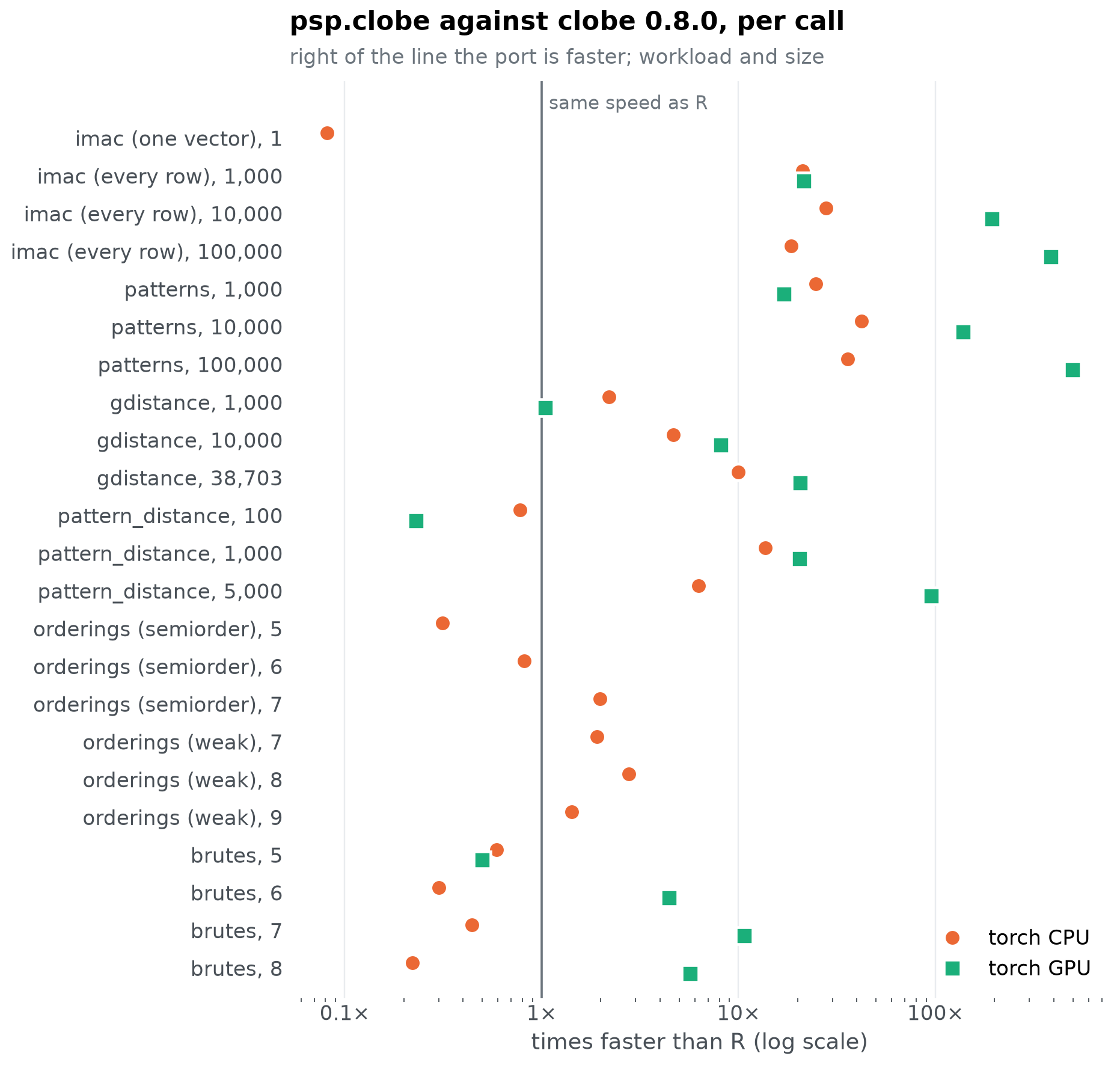
Seconds per call, and how many times faster the port is than the R package (above 1×, the port is faster; below 1×, R is).
speedup = pd.DataFrame({b: seconds[R] / seconds[b] for b in builds})
table = pd.DataFrame({"R": seconds[R].map(duration)})
for b in builds:
    table[short[b]] = seconds[b].map(lambda s: duration(s) if pd.notna(s) else "")
    table[f"{short[b]} vs R"] = speedup[b].map(lambda v: times(v) if pd.notna(v) else "")
table
| R | torch CPU | torch CPU vs R | torch GPU | torch GPU vs R | ||
|---|---|---|---|---|---|---|
| function | size | |||||
| imac (one vector) | 1 | 3.4 µs | 42.4 µs | 0.081× | ||
| imac (every row) | 1000 | 3.85 ms | 181.8 µs | 21× | 179.7 µs | 21× |
| 10000 | 39.00 ms | 1.40 ms | 28× | 200.9 µs | 194× | |
| 100000 | 420.00 ms | 22.72 ms | 18× | 1.09 ms | 386× | |
| patterns | 1000 | 10.40 ms | 420.0 µs | 25× | 612.3 µs | 17× |
| 10000 | 91.00 ms | 2.16 ms | 42× | 658.7 µs | 138× | |
| 100000 | 962.00 ms | 26.80 ms | 36× | 1.94 ms | 496× | |
| gdistance | 1000 | 1.08 ms | 489.6 µs | 2.2× | 1.04 ms | 1× |
| 10000 | 10.60 ms | 2.28 ms | 4.7× | 1.31 ms | 8.1× | |
| 38703 | 31.00 ms | 3.12 ms | 9.9× | 1.51 ms | 21× | |
| pattern_distance | 100 | 109.9 µs | 140.9 µs | 0.78× | 476.0 µs | 0.23× |
| 1000 | 11.80 ms | 859.7 µs | 14× | 576.5 µs | 20× | |
| 5000 | 404.00 ms | 64.60 ms | 6.3× | 4.25 ms | 95× | |
| orderings (semiorder) | 5 | 300.0 µs | 953.2 µs | 0.31× | ||
| 6 | 10.50 ms | 12.86 ms | 0.82× | |||
| 7 | 501.00 ms | 252.53 ms | 2× | |||
| orderings (weak) | 7 | 12.25 ms | 6.42 ms | 1.9× | ||
| 8 | 350.00 ms | 126.04 ms | 2.8× | |||
| 9 | 5.35 s | 3.76 s | 1.4× | |||
| brutes | 5 | 730.8 µs | 1.23 ms | 0.59× | 1.46 ms | 0.5× |
| 6 | 13.00 ms | 43.04 ms | 0.3× | 2.93 ms | 4.4× | |
| 7 | 251.00 ms | 568.23 ms | 0.44× | 23.51 ms | 11× | |
| 8 | 1.53 s | 6.94 s | 0.22× | 269.14 ms | 5.7× |
labels = [f"{f}, {s:,}" for f, s in speedup.index]
y = np.arange(len(labels))[::-1]
fig, ax = plt.subplots(figsize=(8, 9))
ax.axvline(1, color=grey, linewidth=1.2)
ax.annotate("same speed as R", xy=(1, y.max() + 0.9), xytext=(4, 0), textcoords="offset points",
            color=muted, fontsize=10, va="center")
for b, colour in builds.items():
    marker = "o" if "cpu" in b else "s"
    ax.plot(speedup[b], y + (0.14 if "cpu" in b else -0.14), marker, color=colour, markersize=9, markeredgecolor="white",
            markeredgewidth=1.5, linestyle="none", label=short[b])
ax.set_xscale("log")
ax.xaxis.set_major_formatter(lambda v, _: f"{v:g}×")
ax.set_yticks(y, labels)
ax.set_ylim(-0.8, y.max() + 1.5)
ax.grid(axis="y", visible=False)
ax.set_xlabel("times faster than R (log scale)")
ax.legend(loc="lower right")
titled(ax, "psp.clobe against clobe 0.8.0, per call",
       "right of the line the port is faster; workload and size")
show(fig, "speed-against-r")
What the numbers show#
cpu, gpu = "psp-torch cpu float64", "psp-torch cuda float64"


def s(function, size, build):
    return seconds.loc[(function, size), build]


def x(function, size, build):
    return speedup.loc[(function, size), build]


display(Markdown(f'''
**One result at a time is the R package's ground.** `imac()` on a single result takes {duration(s("imac (one vector)", 1, R))} in R and {duration(s("imac (one vector)", 1, cpu))} in the port: every tensor operation costs a few microseconds of dispatch, whatever its size, and building one small matrix takes a handful of them. In a loop over results, as R has to run it, the port would be the slower of the two.

**Batches are the port's ground.** Given all the results at once, `imac()` builds 100,000 matrices in {duration(s("imac (every row)", 100000, cpu))} on the CPU, {times(x("imac (every row)", 100000, cpu))} faster than R's {duration(s("imac (every row)", 100000, R))} for one call per result. `patterns()` adds finding the distinct patterns, which the port does by packing each pattern into one integer and sorting those, where R pastes every pattern into a string: {times(x("patterns", 1000, cpu))} to {times(x("patterns", 100000, cpu))} faster on the CPU. This is also what makes `imac()` a cheap `discretize` for `psp.PSP`, which hands it a whole batch per iteration.

**g-distance and pattern distances** are one call each in both packages. `gdistance()` is {times(x("gdistance", 1000, cpu))} to {times(x("gdistance", 38703, cpu))} faster on the CPU: R compares every human pattern with every model pattern, the port packs the patterns into integers and matches them by sorting. `pattern_distance()` between every pair of 5,000 patterns, 25 million distances, takes {duration(s("pattern_distance", 5000, R))} in R, {duration(s("pattern_distance", 5000, cpu))} on the CPU (in float32, which is exact for integer codes) and {duration(s("pattern_distance", 5000, gpu))} on the GPU, where the distances between patterns of -1, 0 and 1 are computed as matrix products. For the smallest workloads the GPU is no faster than the CPU: a kernel launch costs more than the work.

**Enumerations.** `orderings()` is at its slowest relative to R for few stimuli, where the fixed cost of the tensor operations dominates ({times(x("orderings (semiorder)", 5, cpu))} for the 2,371 semiorders of 5 stimuli, in about a millisecond), and faster for many ({times(x("orderings (semiorder)", 7, cpu))} for the 763,099 semiorders of 7, {times(x("orderings (weak)", 9, cpu))} for the 7 million weak orderings of 9). The port also keeps the matrices as int8, an eighth of the memory of R's doubles, so it can list the 17.6 million semiorders of 8 stimuli (1.1 GB), which in R would take some 18 GB.

**`brutes()`** is where R's multithreaded C++ is strongest. It streams through the assignments on every hardware thread, while the port builds each block of assignments as tensors and sorts their keys: on the CPU the port is {times(1 / x("brutes", 7, cpu))} slower for 11 values and 7 stimuli and {times(1 / x("brutes", 8, cpu))} slower for 8 (214 million assignments, {duration(s("brutes", 8, cpu))} against {duration(s("brutes", 8, R))}). On the GPU the same work takes {duration(s("brutes", 8, gpu))}, {times(x("brutes", 8, gpu))} faster than R.
'''))
One result at a time is the R package’s ground. imac() on a single result takes 3.4 µs in R and 42.4 µs in the port: every tensor operation costs a few microseconds of dispatch, whatever its size, and building one small matrix takes a handful of them. In a loop over results, as R has to run it, the port would be the slower of the two.
Batches are the port’s ground. Given all the results at once, imac() builds 100,000 matrices in 22.72 ms on the CPU, 18× faster than R’s 420.00 ms for one call per result. patterns() adds finding the distinct patterns, which the port does by packing each pattern into one integer and sorting those, where R pastes every pattern into a string: 25× to 36× faster on the CPU. This is also what makes imac() a cheap discretize for psp.PSP, which hands it a whole batch per iteration.
g-distance and pattern distances are one call each in both packages. gdistance() is 2.2× to 9.9× faster on the CPU: R compares every human pattern with every model pattern, the port packs the patterns into integers and matches them by sorting. pattern_distance() between every pair of 5,000 patterns, 25 million distances, takes 404.00 ms in R, 64.60 ms on the CPU (in float32, which is exact for integer codes) and 4.25 ms on the GPU, where the distances between patterns of -1, 0 and 1 are computed as matrix products. For the smallest workloads the GPU is no faster than the CPU: a kernel launch costs more than the work.
Enumerations. orderings() is at its slowest relative to R for few stimuli, where the fixed cost of the tensor operations dominates (0.31× for the 2,371 semiorders of 5 stimuli, in about a millisecond), and faster for many (2× for the 763,099 semiorders of 7, 1.4× for the 7 million weak orderings of 9). The port also keeps the matrices as int8, an eighth of the memory of R’s doubles, so it can list the 17.6 million semiorders of 8 stimuli (1.1 GB), which in R would take some 18 GB.
brutes() is where R’s multithreaded C++ is strongest. It streams through the assignments on every hardware thread, while the port builds each block of assignments as tensors and sorts their keys: on the CPU the port is 2.3× slower for 11 values and 7 stimuli and 4.5× slower for 8 (214 million assignments, 6.94 s against 1.53 s). On the GPU the same work takes 269.14 ms, 5.7× faster than R.
In short#
Use the port’s functions on batches: imac() on all results at once, patterns() and gdistance() on whole sets, and brutes() on the GPU when there is one. The R package is faster for one small call at a time, and its brutes() is faster on a CPU.