



psp-torch#
Parameter space partitioning MCMC for global model evaluation (Pitt, Kim, Navarro & Myung, 2006), in PyTorch, built to evaluate a model on many parameter sets at once, on the CPU or the GPU, and to support the kind of analyses of Dome & Wills (2025).
Parameter space partitioning asks what a model can do: which qualitatively different patterns of
behaviour it produces anywhere in its parameter space, and how much of the space each pattern
occupies. psp-torch finds those regions with a Markov chain Monte Carlo search, and
psp.clobe compares them with the patterns people produce.
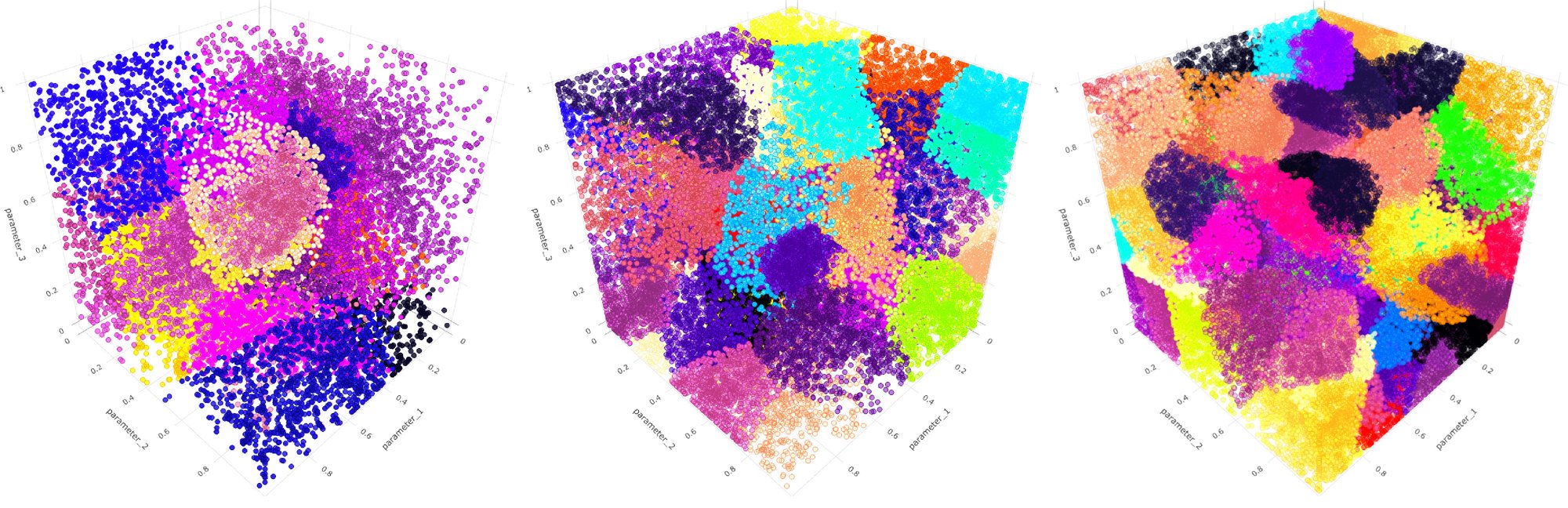
Three parameter spaces, partitioned. Each point is a parameter set the search evaluated, coloured by the ordinal pattern it produced.#
pip install git+https://github.com/lenarddome/psp-torch
Install the package and run a first partition of a two-parameter model.
The interface of psp.PSP(), many runs at once, models written for one parameter set,
and when the GPU pays off.
What can prospect theory predict? And the analysis of Pitt et al. (2006) on ALCOVE.
Inequality matrices, the universal set and g-distance with psp.clobe.
The port against the R package, and when the GPU is worth using.
Every public function and class, from its docstring.
Citation#
If you use psp-torch, please cite the paper the methods were written for:
Dome, L., & Wills, A. J. (2025). g-Distance: On the comparison of model and human heterogeneity. Psychological Review, 132(3), 632–655. https://doi.org/10.1037/rev0000550
Pitt, M. A., Kim, W., Navarro, D. J., & Myung, J. I. (2006). Global model analysis by parameter space partitioning. Psychological Review, 113(1), 57–83. https://doi.org/10.1037/0033-295X.113.1.57